

 Hungarian
 Roman

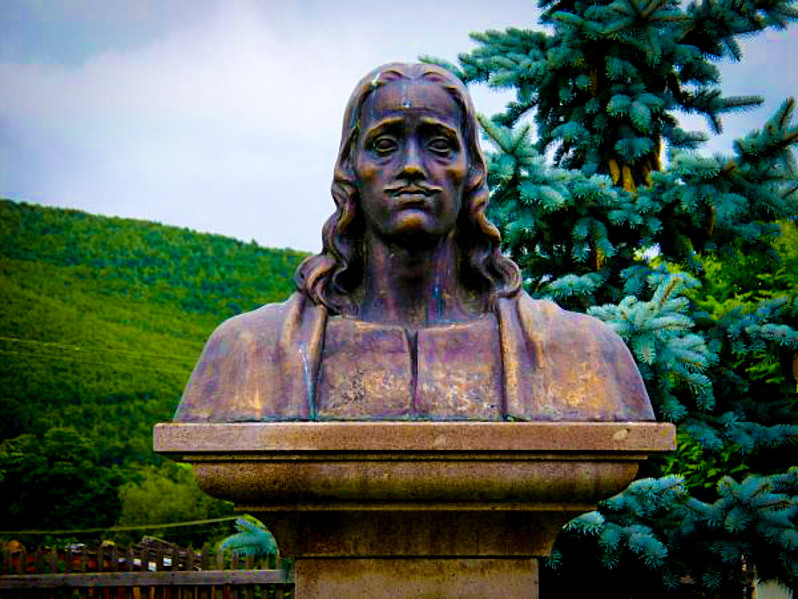
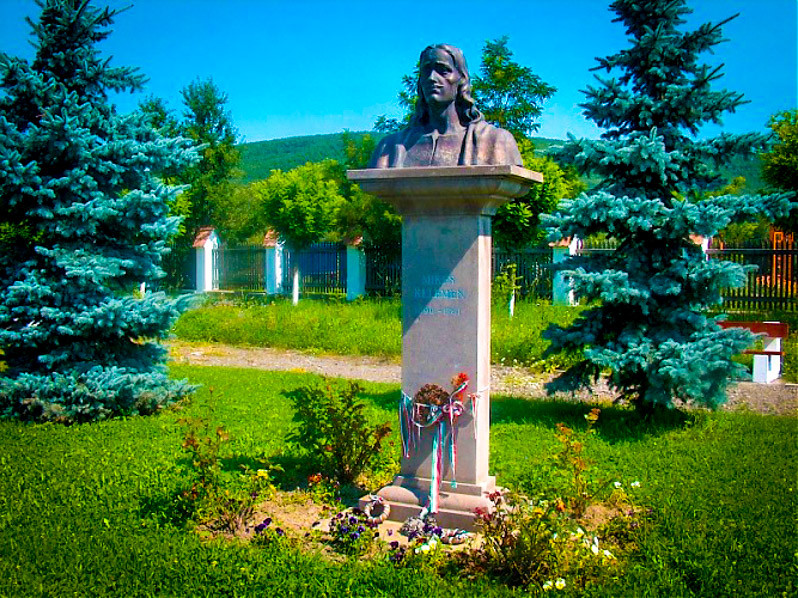
Statue of Mikes Clement of Zagoni
Orbai chair Zagon Zagon, Jud. Covasna
The most prominent figure of the old Hungarian prose was born in Zagon, Trnava in 1690.
"The year 1690 was a particularly black year for the tumultuous end of the century. The baby could cry ... The baby in Mr Zabolai Mikes' palace in Zagoni's noble mansion. Who would have watched him ... Because most of the armed men were in war. under the flags ... The bulk of the work fell on women, girls, and surely no one could hear Eva Thorma screaming in the yard, screaming at the child Clement.
His father's involvement in the Thököly Kuruc movement and his anti-Habsburg fate determined Mikes' thinking and life. (His father was later captured by the emperors and tortured to death in Fagaras.)
He studied in Cluj, then II. He came to the court of Ferenc Rákóczi, where the prince inaugurated the Society of Noble Young People (1707), consisting of one hundred young people. "... the army of this Noble Society is at last set in order ... to bring to our minds, to learn and practice the love of his homeland, together with the divine fear, with more science and good morals ..., the sons of the fathers, all without charge. that they may be adorned with the nobility. " (Ferenc Rákóczi II)
So Mikes became a "noble chap", then a "crawler" apprentice, eventually becoming the prince's chamber.
After the fall of the Kuruc War of Independence, he emigrated with the prince to Poland, France, and then to Turkey (Rhodos).
Returning from Rhodes seemed increasingly unlikely, which was completely stopped by Rákóczi's death in 1735. His former companions died in a row, and he could no longer make friends with the newer emigrants. The pain of loneliness and loyalty to the prince was addressed by József Lévay, 19th century. in the poet Mikes of the 20th century:
"I listen to the murmur of the sea alone,
The sound of the wind running above the foam of the sea,
Alone, alone
Of the hiding places,
Great in Turkey,
Unless he is resting here in his grave
Rákóczi's great soul, the sky flapping
In the wrath of the sea. "
He could never return to his homeland, he died in Rhodes, the epidemic of the century, plague.
He carried with him his heritage of folk attitudes, the taste of the folk language, the folk customs and the Habsburg hatred.
He wrote his experiences in the form of letters, not sent in fictitious (imaginary) letters. He addressed them to his imaginary aunt, the Transylvanian noblewoman in Constantinople, Countess P ... E.
Original title of his letters: "In Constantinople Groff P ... E ... Written Letters M ... K ..." The work was published in 1794 by István Kulcsár, writer and editor in Szombathely, entitled Turkish Letters.
Mikes wrote 207 letters between 1717 and 1758 and became acquainted with the genre during his stay in Paris. In his time of hiding, writing letters was his consolation and his most important pastime.
He purposefully sought to articulate the leaves, he said, "... the beautifully written letter is what the mind likes, and the eye is dill and sour cream-cabbage, which from a distance is like a little silver tip that, if removed silver cover, underneath you can find precious grass. "
The work became unique through its style of "chat", a sincere confession written in a witty conversation style. It is based on the Szekler vernacular and its turns, humor and linguistic comic. For example, the craving for homeland is played out in a playful voice: "... I love Rodosto so much that I can't forget Zagon" or "... in great cheerfulness, we are so happy that we will die in our sin".
Mikes is associated with two concepts, loyalty and love of the motherland:
"There is a faint star pointing towards Zagon,
Where a snow crown shines on the skis,
And at the bottom of the sketches
Spring splendor
Flowers shine.
He points to Transylvania, where all the flowers are
As a colorful butterfly, my first youth
They fly in memory. "(József Lévay: Mikes)